
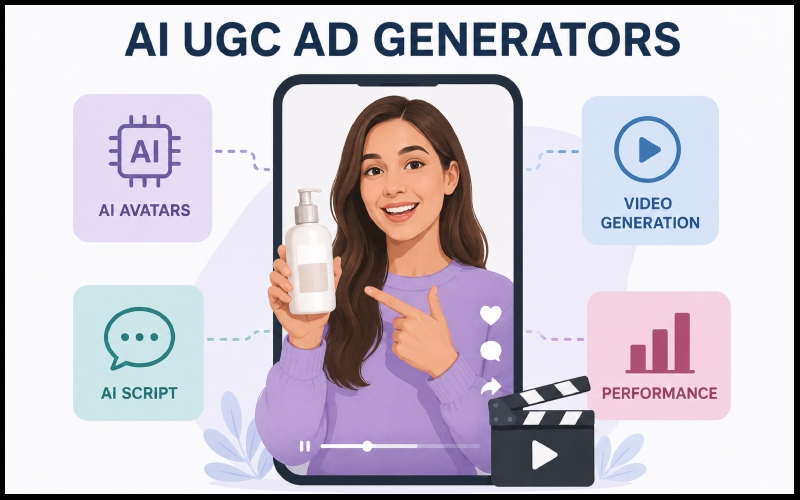
The short answer: The best AI UGC ad generators of 2026 are Magic Hour, Arcads, Creatify, HeyGen, Synthesia, Topview, Captions, Colossyan, VEED, and Predis.ai. Each fits a different budget, workflow, and creative goal.
Hiring real UGC creators used to be the only way to produce authentic, scroll-stopping social ads. That math has changed. Testing 50 ad variants with human creators costs somewhere between $7,500 and $10,000 when you factor in briefs, revisions, and usage rights. The same 50 variants with an AI UGC ad generator costs under $200.
The quality has caught up too. As of mid-2026, the best platforms produce videos that are difficult to distinguish from real creator content on short-form formats. The challenge now is choosing the right tool, because the category has splintered into specialists with very different strengths.
I spent two weeks testing every platform on this list using real product briefs, comparing output quality, workflow speed, actor realism, and value at each price point. What follows is a practical breakdown of what each tool actually does well, and where it falls short.
I guarantee at least one of these tools will match your workflow.
At a Glance: Best AI UGC Ad Generators of 2026
| Tool | Best For | Free Plan | Starting Price | Key Feature |
| Magic Hour | All-in-one UGC, face swap, lip sync | Yes (no signup needed) | Free / $10/mo | 1,000+ actors, multi-step workflows, API |
| Arcads | Realistic AI actors, batch creation | No | $100/mo | 300+ actors, natural micro-expressions |
| Creatify | URL-to-video for ecommerce | Yes (10 credits) | $19/mo | Auto product scraping, script generation |
| HeyGen | Custom avatars, localization | Yes (3 videos/mo) | $24/mo | 175+ languages, voice cloning |
| Synthesia | Enterprise training and corporate ads | No | $22/mo | 230+ avatars, 140+ languages |
| Topview | Ecommerce automation, video cloning | Yes | $16/mo | Product avatar holding, style cloning |
| Captions | Mobile creators, real footage polish | Yes (watermark) | $12/mo | Eye contact correction, lipdub |
| Colossyan | Testimonials, B2B content | No | $21/mo | 70+ language auto-translate |
| VEED | Editable UGC with in-browser tools | Yes (watermark) | $18/mo | Creation plus editing in one place |
| Predis.ai | Budget all-in-one social content | Yes | $32/mo | Social scheduling plus ad creation |
1. Magic Hour
The best all-in-one platform for UGC ads, social content, and beyond.
Magic Hour earns the top spot not because it is narrowly the best at any single feature, but because it is the most complete platform for creators and marketers who want a full creative toolkit without managing five separate subscriptions.
The AI UGC ad generator at Magic Hour gives you access to over 1,000 diverse AI actors. You choose an actor, set the first frame including pose, background, and product placement, enter your script, and generate. The output is a ready-to-use vertical video ad formatted for TikTok, Reels, or paid social.
What separates Magic Hour from the rest of this list is the ecosystem around that core feature. Face swap, lip sync, talking photos, image-to-video, video-to-video, and text-to-video are all available in the same platform, and one-click multi-step workflows let you generate, upscale, and extend a video without leaving the interface. Credits never expire, parallel generations run without a concurrency cap, and the platform works on both desktop and mobile.
No signup is required to test it. That alone is worth noting in a category where most competitors make you hand over a credit card before you see a single frame.
Pros:
- No signup needed to try the product
- 1,000+ diverse AI actors for UGC video creation
- Access to frontier AI models including Kling 3.0, Veo 3.1, Sora 2, and LTX-2
- One-click multi-step workflows: generate, upscale, and extend in sequence
- Face swap, lip sync, and talking photo tools built into the same platform
- Credits never expire, no concurrency cap on parallel generations
- Click-to-create templates reduce friction for new users
- Full API parity across all tools for developers
- Weekly feature releases
- Trusted by teams at Meta, NBA, L’Oreal, Shopify, and Dyson
- Unusually generous free tier with daily credit replenishment
- Strong value at $10 to $15 per month on annual plans
- Founder-level support responsiveness
Cons:
- Premium model generations (Veo 3.1, Sora 2) consume more credits per run
- Free tier capped at 576px resolution
- Full 4K output requires the Business plan
If you want a single platform that handles UGC ad creation alongside every other format your content calendar demands, including face swap for product demos, lip sync for spokesperson localization, and image-to-video for visual storytelling, Magic Hour is the most complete option in this category. The combination of a zero-friction free tier and multi-tool depth makes it genuinely hard to replace.
Pricing:
- Free: 400 credits on signup, 100 daily credits, no account required to test
- Creator: $15/month ($10/month billed annually)
- Pro: $39/month ($25/month billed annually)
- Business: $99/month ($66/month billed annually)
2. Arcads
Arcads is built specifically for UGC-style talking-head ads, and it shows. The platform has one of the deepest AI actor libraries in the category, with over 300 avatars covering a wide range of demographics, presentation styles, and emotional registers. The micro-expressions and natural hand gestures make the output feel more authentic than what most competitors produce.
The batch creation workflow is designed for volume. You feed in multiple scripts, select actors, and generate a full set of variations in a single session. For performance marketers running split tests across many ad sets, that throughput has real value.
The limitation is cost. At $100 per month for the starter plan, Arcads is the most expensive entry point on this list. For teams producing 50 or more UGC videos per month, the per-video economics work out. For lighter use cases, the price is hard to justify.
Pros:
- Best-in-class avatar realism with natural micro-expressions and hand gestures
- 300+ diverse AI actors covering multiple demographics
- Batch creation for high-volume ad testing
- Script generation with multiple hook variations built in
- Translation support in 30+ languages
- Built-in B-roll, music, and caption addition
Cons:
- Most expensive starter plan in the category at $100/month
- No free trial makes it difficult to evaluate before committing
- Actor customization is limited compared to platforms with voice cloning
If you run a DTC brand or performance agency producing heavy UGC volume for Meta and TikTok and your primary metric is avatar realism, Arcads is the strongest dedicated option. Just make sure the economics of the plan work at your actual production volume.
Pricing: Starts at $100/month based on video credit volume.
3. Creatify
Creatify takes a product-first approach that is genuinely useful for ecommerce brands. The signature feature is URL-to-video: paste a product page link and the platform scrapes product images, descriptions, and selling points, then builds a complete UGC-style video ad with script, avatar, and visuals in minutes. No brief writing, no manual asset gathering.
The AI script generation is particularly strong at structuring hooks, which is the hardest part of UGC creative to get right. Creatify gives you a solid first draft that you refine rather than build from scratch.
The main weakness, according to multiple independent reviews, is voiceover quality. The voice synthesis trails what Arcads and HeyGen produce, which matters because voice delivery is half of what makes a UGC ad feel authentic.
Pros:
- URL-to-video pipeline automates product ad creation end to end
- Competitive entry pricing at $19/month
- Strong AI script writing with hook-optimized structures
- 1,000+ avatars on higher plans
- Good batch mode for generating multiple variations quickly
- 10 free credits on signup for testing
Cons:
- Voiceover quality is a commonly cited weak point
- Credit system can be confusing for tracking per-video costs
- Less specialized for the creator-style aesthetic compared to Arcads
For ecommerce brands that need to convert product pages into video ads quickly and at scale, Creatify’s URL-to-video pipeline is a genuine time saver. The voiceover issue is real, so test it with your specific product and audience before committing.
Pricing: Free (10 credits on signup); Basic from $19/month; Pro up to $499/month.
4. HeyGen
HeyGen is the most versatile platform on this list. With over 1,100 avatars and support for 175+ languages, it handles UGC ad creation alongside localization, custom avatar cloning, and enterprise video workflows better than any single-purpose tool.
The standout feature is video translation. Upload an existing ad in English and HeyGen translates it into any supported language with synchronized lip movements. For brands running international campaigns, this removes the need to produce separate creative for each market.
Custom avatar creation is also accessible here. Upload two minutes of video footage and HeyGen builds a digital spokesperson that matches your likeness and voice. Brands can scale a real person’s presence across dozens of ad variations without scheduling additional shoots.
Pros:
- Largest avatar library in the category at 1,100+
- 175+ language support with accurate lip sync
- Custom avatar creation from a short video recording
- Voice cloning with natural emotional range
- Strong free tier (3 videos per month) for testing
- Regularly updated with new avatar and feature releases
Cons:
- Not built specifically for ad workflows (no performance forecasting or campaign management)
- Higher-quality custom avatars require Business plan
- Customer support response times can be slow at lower tiers
- Video length is capped on basic plans
HeyGen is the right choice if multilingual reach and custom avatar consistency are your top priorities. For brands that need a single spokesperson across global markets without reshooting, this is the most capable platform.
Pricing: Free (3 videos/month); Creator at $24/month; Business plans from $29/month with unlimited avatar cloning.
5. Synthesia
Synthesia is the enterprise standard for AI avatar video. The platform serves teams that need compliant, professionally polished video at scale, with 230+ avatars, support for 140+ languages, and SSO and API access that larger organizations require.
The avatars lean toward a polished spokesperson aesthetic rather than the casual creator style that makes UGC feel native. For B2B brands, corporate advertisers, and training content teams, that professionalism is a feature. For DTC brands running TikTok and Reels ads, it can work against the authentic feel that drives engagement.
Synthesia is mature, stable, and well-documented. If you need enterprise governance, audit trails, and compliance features alongside AI video generation, nothing else on this list matches it.
Pros:
- Enterprise-grade stability and compliance features
- 230+ professional avatars with high consistency
- 140+ language support for global content at scale
- SSO, API access, and team collaboration built in
- Strong track record and established user community
Cons:
- Avatar aesthetic leans corporate rather than creator-style
- Less suited for native social ad formats compared to UGC specialists
- No free trial available at most plan tiers
Synthesia is the right pick for enterprise teams producing training content, product explainers, and localized marketing video where brand professionalism matters more than feed-native authenticity.
Pricing: Starter from $22/month; Creator and higher tiers available for teams and enterprise needs.
6. Topview
Topview calls itself an AI Video Agent, and the framing is accurate. You feed it a product URL or image, optionally reference a video style you want to replicate, and the platform handles scripting, avatar selection, voiceover, captions, and rendering without manual steps in between.
The Product Avatar feature is the most distinctive element: it generates an AI presenter who appears to actually hold and interact with your product on screen. For product review content, unboxing ads, and demo-style creatives, this is a meaningful differentiator that most competitors do not offer.
At $16 per month, Topview is also the most affordable paid option on this list, making it worth testing for solo marketers and small teams before committing to higher-tier tools.
Pros:
- Product Avatar feature shows AI presenters interacting with your product
- Lowest paid plan price in the category at $16/month
- Video style cloning from reference clips
- TikTok ad library for creative inspiration
- 5,000+ public avatars on paid plans
- Includes image generation models alongside video
Cons:
- Lip sync falls out of rhythm approximately 20% of the time by independent assessment
- More automation-heavy workflow can feel opaque for teams wanting granular control
- Newer platform with a smaller established user community
Topview is one of the best value options in this category, particularly for ecommerce brands who want product interaction in their ads. Test the free tier before upgrading.
Pricing: Free tier available; Pro from $16/month; Business and higher tiers available.
7. Captions
Captions approaches UGC from the creator side rather than the advertiser side. It is a mobile-first app that helps real creators produce better-looking content faster, rather than replacing creators with AI avatars entirely.
The AI eye contact correction is the signature feature: it adjusts footage so subjects appear to be looking directly at the camera even when reading from a script. That detail makes a significant difference in how engaging the final video feels to viewers. Combined with animated caption styles built for TikTok and Reels aesthetics, the output blends naturally into social feeds.
For teams working with real creators who want to polish content and run variation tests without additional shoots, Captions is genuinely useful. For pure AI avatar UGC without a human creator, it is not the right tool.
Pros:
- AI eye contact correction is unique and practically valuable
- Built specifically for short-form social aesthetics
- Lipdub for iterating on scripts post-recording without reshoots
- Accessible pricing at $12/month
- Free tier for testing before committing
Cons:
- Not a pure AI UGC generator; depends on real footage for best results
- Smaller avatar library than competitors
- Less ad-specific compared to Arcads or Creatify
If you already work with creators or produce your own short-form video and want AI tools to polish and scale that content, Captions is the strongest option at its price point.
Pricing: Free (watermarked exports); Pro plans start at $12/month.
8. Colossyan
Colossyan occupies a niche between enterprise polish and talking-head authenticity. Its avatars are well-suited to direct-to-camera testimonial formats, and the auto-translate feature stands out: produce a script in English and Colossyan generates versions in 70+ languages with matching lip sync and natural-sounding accents.
For SaaS companies and B2B brands that need localized testimonial-style content without separate creator partnerships in each market, that language capability has genuine operational value. The avatar library is smaller than most competitors, and gesture range is more limited than Arcads, but output quality for talking-head formats is consistently solid.
Pros:
- Auto-translate into 70+ languages with lip sync included
- Solid talking-head output well-suited for testimonial formats
- Accessible starter pricing
Cons:
- Smaller avatar library than Arcads and HeyGen
- Limited gesture and expression range
- No offline mode; requires internet for editing
For B2B companies and SaaS brands that prioritize multilingual testimonial content over high-volume social ad creative, Colossyan is a strong, focused option.
Pricing: Starter from $21/month; higher tiers for team features and expanded avatar access.
9. VEED
VEED combines AI UGC generation with a full in-browser video editor, which is its main differentiator. If you need to generate a UGC-style ad and then refine it without switching tools, VEED gives you both in one interface.
The avatar selection is smaller than the dedicated UGC specialists, and the tool feels more editor-first than generator-first. For teams that already use VEED for video editing and want to add UGC-style content to that workflow, the extension feels natural. For teams buying specifically for AI UGC ad volume, there are more specialized options.
Pros:
- Combined generation and editing in one interface
- Accessible entry pricing
- Free tier for light use
- Suitable for teams already familiar with browser-based editing
Cons:
- Smaller avatar library than dedicated UGC tools
- More editor-first than ad-workflow-first
- Less tailored for high-volume batch generation
VEED is the right fit for marketers who value editing control over generation volume and want to keep their workflow inside one product.
Pricing: Free (watermarked); Lite from $18/month; Pro and Business tiers available.
10. Predis.ai
Predis.ai takes the broadest approach of any tool on this list. It is an all-in-one social content platform that combines UGC-style video generation, AI image ads, social scheduling, competitor analysis, and copywriting in one product.
The UGC video output is competent but not the strongest on this list. The real value is in the breadth: if you are a solo marketer or small business that needs social ads, captions, scheduling, and content ideas from a single tool under $35 per month, Predis covers all of it without requiring separate subscriptions.
Pros:
- Most complete all-in-one social content tool in this category
- Competitor ad analysis included
- Multi-platform publishing from within the tool
- Accessible pricing with a free tier
- AI copywriting for captions and scripts alongside video
Cons:
- UGC video quality does not match the dedicated video platforms
- Avatar realism lags behind Arcads, Creatify, and HeyGen
- Less suited for high-volume video testing
If you are an early-stage brand or solo marketer who needs to cover multiple content formats efficiently without a large budget, Predis.ai delivers more per dollar than almost anything else on this list.
Pricing: Free plan available; paid plans from $32/month
How We Chose These Tools
I evaluated each platform over two weeks using consistent test briefs across three product categories: a DTC skincare product, a SaaS tool, and a physical consumer product.
Output quality was assessed on avatar realism, lip sync accuracy, voice naturalness, and how closely the final video resembled genuine creator content rather than obvious AI output.
Workflow speed covered the time from brief or product URL to a downloadable video, including how much manual setup each step required.
Value per dollar compared credits, video output volume, and included features against monthly cost at free, entry, and mid-tier plans.
Ecosystem breadth measured whether the platform offered companion tools (face swap, lip sync, image generation, analytics) that reduce the number of separate subscriptions needed.
Free tier practicality assessed whether the free plan actually lets you evaluate output quality before committing to payment.
I gave higher weight to tools that work reliably on real product briefs rather than polished demo content. Marketing teams make decisions based on what the tool does with their actual products and scripts.
The Market Landscape: Where AI UGC Is Heading
The AI UGC category in 2026 is maturing quickly. A few trends are worth tracking for anyone building workflows around these tools.
Cost per video is collapsing. Independent research cited across this space consistently shows AI UGC at $2 to $20 per video against $150 to $2,000 for human creators. That gap is only widening as competition drives platform pricing down.
Realism is no longer the differentiating factor at the top. The leading platforms have largely solved the uncanny valley problem for short-form content under 60 seconds. The new competition is on workflow integration, multi-platform output, and how tightly the tools connect to media buying.
Product-aware avatars are the next frontier. Topview’s Product Avatar feature, where the AI presenter physically interacts with the product in frame, points to where avatar video is heading. Expect other platforms to add similar product integration capabilities through 2026 and 2027.
Multi-model platforms are gaining ground. Tools like Magic Hour that offer UGC generation alongside face swap, lip sync, image-to-video, and other formats from a single credit pool are increasingly attractive to teams that used to manage separate subscriptions for each workflow.
Localization is becoming standard. 175-language support from HeyGen was a premium differentiator two years ago. It is now expected at the top tier of most competitive platforms.
Emerging tools worth watching include Reloop for AI-agent-driven script iteration, and continued model improvements from both Arcads and HeyGen that are shipping on rapid release cycles.
Final Takeaway: Which Tool Is Right for You
You want the most complete platform with UGC generation, face swap, lip sync, and frontier models: Magic Hour. The combination of a zero-friction free tier, 1,000+ actors, multi-step workflows, and companion tools makes it the strongest all-around choice for creators and marketing teams.
You need the most realistic AI avatars for Meta and TikTok at high volume: Arcads. Worth the price if your monthly output justifies the $100 starting plan.
You run an ecommerce brand and need URL-to-video at scale: Creatify. The product scraping pipeline is genuinely fast. Test the voiceover quality on your use case before committing.
You need multilingual reach or custom avatar cloning: HeyGen. Nothing in this category matches its 175-language coverage and custom avatar accessibility.
You work with a real creator and want to polish and iterate: Captions. Eye contact correction and lipdub are practically useful features that nothing else on this list replicates.
You need enterprise governance alongside AI video: Synthesia. The compliance and SSO features matter at that scale.
You want the lowest-cost entry point with solid output: Topview at $16/month is the best value in the paid tier.
The most important step is to test before you buy. Most platforms on this list offer free trials or free tiers. Run your actual product brief through two or three tools and let the output quality tell you which one fits your use case.
FAQ
What is an AI UGC ad generator?
An AI UGC ad generator is a platform that creates creator-style video ads using AI avatars, voice synthesis, and script generation rather than real human creators. The output mimics the authentic, direct-to-camera aesthetic of user-generated content while giving brands control over the script, actor appearance, and product presentation.
Are AI UGC ads allowed on Meta, TikTok, and YouTube?
Yes. AI-generated video ads are allowed on all major platforms including Meta (Facebook and Instagram), TikTok, and YouTube. As of 2026, Meta requires “AI-generated” labels for photorealistic human portrayals. Platforms using commercially licensed AI avatars have a high ad approval rate when content follows standard advertising policies.
How much does AI UGC content cost compared to real creators?
AI UGC typically costs $2 to $20 per video through subscription plans. Human creator content costs $150 to $2,000 per video including briefing, revisions, and usage rights. Testing 50 ad variants with human creators costs $7,500 to $10,000. The same test with an AI tool costs under $200.
Which AI UGC tool is best for a small budget?
Captions at $12/month and Topview at $16/month offer the most practical entry points for small teams. Magic Hour’s free tier with daily credit replenishment is the best zero-cost starting point for testing AI UGC alongside other content formats.
Do I need video editing skills to use these tools?
No. Every platform on this list is built for users without a video editing background. The workflow is typically: choose an actor or avatar, enter a script or product URL, set basic parameters, and generate. Advanced editing is optional on platforms like VEED and Captions, but it is not required to produce a finished ad.

Jack Ayzal is the lead editor of Trending Magazine. He focuses on practical home improvement, real-estate decisions, and local service guidance. For the past eight years he has researched contractor practices, spoken with homeowners and tradespeople, and tracked how local rules and market conditions affect everyday projects. His aim is to give readers clear, usable information they can act on without sales pressure.