
Table of Contents
- Evolution of Payroll Systems
- Key Features of Modern Payroll Technology
- Impact on Employee Satisfaction
- Compliance and Risk Mitigation
- Case Studies of Successful Implementation
- Future Trends in Payroll Technology
- Conclusion
In today’s rapidly evolving business landscape, businesses are increasingly focused on efficiency to stay competitive. Nowhere is this more apparent than in human resources and payroll management, where the latest technological advancements are delivering new levels of accuracy, transparency, and compliance. As organizations strive to simplify their workforce operations, next-generation payroll solutions are stepping forward, driven by artificial intelligence, data analytics, and employee empowerment tools. Notably, industries such as restaurants are leveraging tip pooling software and other cutting-edge payroll management tools to revolutionize how pay is tracked, reported, and distributed.
Automated payroll processing, intuitive dashboards, and self-service features are quickly replacing outdated systems that relied on manual data entry and time-consuming calculations. This streamlining ensures prompt, accurate pay while minimizing regulatory compliance risks. These digital innovations help control labor costs, reduce errors, and strengthen workforce satisfaction, reinforcing the importance of payroll technology as a core business function.
Evolution of Payroll Systems
Payroll management has undergone significant changes in recent decades, shifting from manual methods fraught with human error to automated, digital solutions. Modern payroll technology leverages artificial intelligence and machine learning to provide real-time data analysis, enhanced compliance updates, and predictive insights. These innovations streamline payroll processes, improving reliability and aligning them more closely with workforce management objectives. Transitioning to cloud-based platforms allows businesses to gain comprehensive insights into labor trends and compliance risks, enabling quicker responses and cleaner audits. Additionally, these systems enhance transparency, benefiting both organizations and employees by minimizing pay-related conflicts. Cloud payroll solutions’ adaptability supports business growth and expansion into new markets while reducing administrative burdens and errors. This integration of payroll into broader management discussions opens up new strategic opportunities for organizations.
Key Features of Modern Payroll Technology
Several modern features set today’s payroll technology apart from its predecessors:
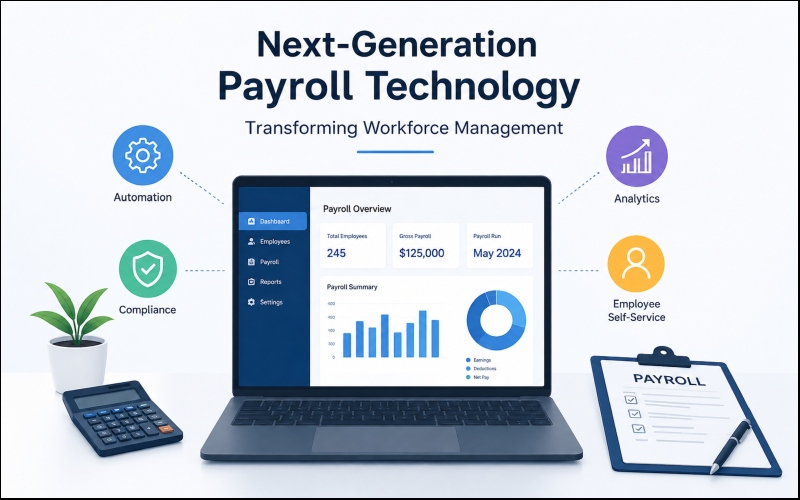
- Automated Payroll Processing: Automated systems minimize manual tasks and paperwork, handling regular and off-cycle payments, deductions, bonuses, and even last-minute changes, all with maximum efficiency and accuracy.
- Real-Time Data Analysis: Leveraging built-in analytics tools allows businesses to monitor payroll expenditure, track overtime, and analyze headcount trends in real time, enabling better financial forecasting.
- Compliance Management: Modern payroll solutions are continually updated to comply with changing tax codes, labor regulations, and jurisdictional requirements, protecting businesses from compliance errors and related penalties.
- Employee Self-Service Portals: Employees can now access their pay stubs, tax forms, and other payroll information online at any time, promoting autonomy and reducing HR inquiries.
Additionally, integrations with mobile applications and accounting software are extending payroll accessibility and accuracy beyond traditional office settings. Feature sets now include mobile clock-ins and integrations with workforce management tools, making it much easier to coordinate payroll with scheduling and attendance data. AI-powered chatbots and virtual assistants are also emerging, allowing HR officers and employees to get real-time answers to payroll questions and assisting with administrative duties. These new functionalities reduce friction between HR and employees, free up human capital for value-added tasks, and ultimately enable a more agile, competitive workplace.
Impact on Employee Satisfaction
Payroll accuracy and transparency are essential to employee satisfaction and retention. Late payments or paycheck errors can erode trust and increase turnover. When companies implement advanced systems that guarantee regular, error-free paychecks, employees develop a greater sense of security and loyalty. These solutions also let staff review historical payments, track time off, and manage benefits independently, further boosting engagement. Studies from sources such as SHRM reveal that payroll satisfaction closely correlates with overall job satisfaction, underscoring the broader impact of effective payroll technology.
Furthermore, access to digital pay information streamlines processes such as loan applications and personal finance management outside the workplace, as workers can instantly access proof of income or historical pay records. When employees feel confident about the reliability, transparency, and timeliness of their payments, especially in customer-facing fields such as retail or hospitality, this positive experience can translate into better customer service, improved morale, and stronger team cohesion. Employers who communicate the value of next-gen payroll solutions demonstrate an investment in their workforce’s well-being and stability, fostering loyalty and long-term retention.
Compliance and Risk Mitigation
Staying compliant with complicated, often-changing labor and tax regulations is a challenge for businesses of all sizes. Next-generation payroll systems include automated updates and alerts for new laws, as well as rule-based engines designed to flag inconsistencies or potential risks in real time. For example, products like UKG’s Pro Pay with Workforce AI use intelligent automation to detect and correct payroll issues in real time, reducing exposure to compliance-related fines and litigation.
Case Studies of Successful Implementation
Many organizations have already achieved success through next-gen payroll solutions. A leading example is Intuit’s QuickBooks Workforce, an AI-based human capital management platform designed for growing businesses that need robust payroll and workforce management without the enterprise-level complexity. The solution streamlines payments, integrates compliance checks, and simplifies benefits administration, freeing up HR staff for more strategic initiatives.
Other successful case studies highlight small and medium-sized enterprises that have adopted cloud-based payroll platforms, resulting in reduced processing time and improved accuracy. These organizations frequently report cost savings from reduced administrative overhead and fewer regulatory violations after transitioning from legacy solutions. The ability to scale payroll functions as businesses grow, or during seasonal fluctuations, demonstrates the flexibility and long-term value of these advanced platforms for businesses across industries.
Future Trends in Payroll Technology
Payroll tech will evolve with AI analyzing data, ensuring compliance globally. Data security remains crucial, with advanced encryption protecting sensitive info. Multiregion businesses demand systems that unify pay across jurisdictions, currencies, and laws. As remote and hybrid work grow, cloud-based payroll solutions will be standard. Blockchain can create tamper-proof records with transparent audits and automated taxes. Employee financial wellness tools and earned wage access are rising, transforming payroll into a talent and well-being asset. As systems adapt, companies will use payroll insights to enhance policies and boost productivity.
Conclusion
Next-generation payroll technology is redefining the possibilities of workforce management. Automation, real-time analytics, compliance updates, and employee empowerment contribute to improved business performance and a more engaged workforce. Companies investing in these innovations are well-positioned to navigate the evolving workplace, deliver accurate, on-time payroll, and foster trust among employees. As the pace of change accelerates, forward-thinking businesses will continue to turn to advanced payroll solutions to ensure operational excellence and workforce satisfaction. The future of payroll management, shaped by continued innovation, promises new opportunities for both businesses and their employees alike.

Jack Ayzal is the lead editor of Trending Magazine. He focuses on practical home improvement, real-estate decisions, and local service guidance. For the past eight years he has researched contractor practices, spoken with homeowners and tradespeople, and tracked how local rules and market conditions affect everyday projects. His aim is to give readers clear, usable information they can act on without sales pressure.