
The days when marketing was purely about catchy slogans and “gut feelings” are long gone. If you walk into a modern marketing agency today, you’ll find that the creative team is heavily supported by data scientists and analysts. For undergraduate students, this shift is the single most important trend to understand before entering the workforce. It is no longer enough to know how to design a beautiful ad; you have to know who is looking at it, why they clicked, and what they will do next.
The transition from traditional to digital-first strategies means that data is the new currency. Students often feel overwhelmed by the technical side of their degree, especially when theoretical concepts turn into complex practical tasks. It is quite common for learners to look for reliable assignment help au from professionals at Myassignmenthelp Services to manage the heavy workload of case studies and market reports. Getting a handle on these foundational tasks early allows you to focus on the bigger picture: how data informs the creative process.
The Shift from Creativity to Connectivity
Marketing has always been about making a connection. However, the medium of that connection has changed. In the past, a billboard on a busy highway was a guessing game. Today, every “like,” “share,” and “scroll” provides a data point. For a student, mastering analytics means learning how to translate those digital footprints into a story. It’s about connectivity—linking a consumer’s behavior to a brand’s growth.
When you understand analytics, you aren’t just looking at numbers; you are looking at human psychology in real-time. You can see exactly where a customer lost interest in a website or what time of day they are most likely to buy a product. This level of insight is what makes a modern marketer indispensable to a business.
Why Statistics is the Foundation of Modern Marketing
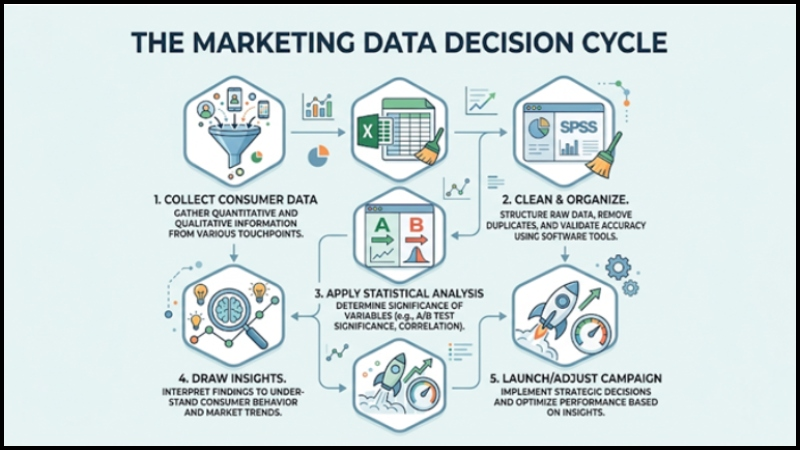
While the “creative” side of marketing gets the spotlight, the “quantitative” side does the heavy lifting. This is where many students hit a wall. To run a successful A/B test or to understand market segmentation, you need a firm grasp of statistical significance. You need to know if a 5% increase in sales was a result of your new campaign or just a random fluctuation in the market.
Many undergraduates find that quantitative units are the most challenging part of their syllabus. Mastering software like SPSS or understanding regression models can be daunting when you are also trying to learn brand management. Because of this complexity, specialized Statistics Assignment Help through Myassignmenthelp Services has become a vital resource for those who want to ensure their data interpretation is accurate. Using expert guidance helps bridge the gap between staring at a confusing spreadsheet and actually drawing meaningful conclusions that could win over a boardroom.
Bridging the Skills Gap: What Employers Want
If you look at entry-level job descriptions for marketing coordinators or social media managers, “proficiency in Google Analytics” or “data visualization skills” are almost always listed as requirements. Employers are looking for “T-shaped” individuals—people who have a broad knowledge of marketing but a deep, specialized skill in data.
| Skillset | Traditional Marketing | Data-Driven Marketing |
| Focus | Mass Communication | Personalization & Targeting |
| Decision Making | Intuition & Experience | Real-time Data & Testing |
| Success Metric | Brand Awareness | ROI & Conversion Rates |
| Primary Tools | TV, Print, Radio | SEO, CRM, Heatmaps |
The Role of Predictive Analytics
One of the most exciting areas for students to explore is predictive analytics. This involves using historical data to predict future consumer behavior. Amazon knows what you want to buy before you do; Netflix suggests shows based on your viewing history. This isn’t magic; it’s math.
By learning how to handle these data sets, you position yourself at the forefront of the industry. You aren’t just reacting to what happened yesterday; you are preparing the brand for what will happen tomorrow. This proactive approach is what separates a junior staffer from a strategic manager.
Making Information Readable: The Visual Element
In a world of information overload, the best marketers are those who can simplify the complex. This is why data visualization is a core part of analytics. You might have the best data in the world, but if you can’t present it in a way that a CEO understands, it loses its value.
As a student, you should practice turning your assignment findings into charts, infographics, and tables. This not only makes your work more “readable” and professional but also mirrors the type of reporting you will do in a real-world job. Clear communication of data is just as important as the data itself.
Overcoming the Fear of Tech
It is okay to feel intimidated by the technical side of marketing. Many students chose this field because they enjoy the social and creative aspects, not because they wanted to spend hours in Excel. However, the “tech” is just a tool, like a paintbrush or a camera. Once you learn the basics, the software does the hard work for you.
The key is to start small. Learn the terminology first—understand what a “Bounce Rate” is or what “Cost Per Acquisition” (CPA) means. Once the language feels familiar, the actual analysis becomes much less frightening. Remember, every expert was once a beginner who felt exactly how you do now.
Conclusion: Future-Proofing Your Career
Mastering data analytics is the best way to future-proof your career. While AI and automation are changing how we schedule posts and write basic copy, the ability to interpret data and make strategic human decisions is something that cannot be easily replaced. By embracing the numbers now, you are giving yourself a massive competitive advantage.
Marketing will always need the “human touch,” but that touch is much more powerful when it is backed by evidence. As you move through your undergraduate journey, look at every data-heavy assignment as an opportunity to build a bridge to your future career.
Frequently Asked Questions (FAQ)
1. Do I need to be a math genius to succeed in marketing analytics?
Ans: Not at all. While you need a basic understanding of statistics, most modern marketing tools handle the heavy calculations for you. Your job is to interpret the “why” behind the numbers.
2. Which tools should I start learning first?
Ans: Google Analytics 4 (GA4) is the industry standard. Additionally, learning the basics of Excel (pivot tables and VLOOKUPs) and a visualization tool like Tableau or Canva for data reports is a great start.
3. Why is statistics specifically mentioned as a requirement for marketing?
Ans: Statistics allows you to prove that your results are valid. Without it, you’re just guessing. It helps in predicting trends and understanding if a specific group of customers is truly different from another.
4. How can I balance learning creative skills and technical data skills?
Ans: Think of them as two sides of the same coin. Try to apply data to your creative projects. For example, if you design a social media campaign, use analytics to see which colors or headlines performed better.
5. Is data analytics useful for small businesses too?
Ans: Absolutely. In fact, small businesses often rely even more on data because they have smaller budgets and cannot afford to waste money on marketing that doesn’t work.
About The Author
I am Min Seow, a Senior Academic Consultant and Content Strategist at Myassignmenthelp Services. With a background specializing in STEM education and digital literacy, I focus on helping undergraduate students bridge the gap between complex theoretical concepts and practical application.
For more information and suggestions, please contact us.