

The feeling of being “in the zone” is not a mystery reserved for elite athletes or world-class musicians. It is a psychological state known as Flow, where time seems to vanish, and your productivity reaches a level of effortless precision. In a world defined by constant digital interruptions and shrinking attention spans, the ability to trigger this state on demand is the ultimate competitive advantage. To access your peak performance zone, you must understand that focus is not about trying harder; it’s about creating an environment where your brain has no choice but to engage deeply with the task at hand.
Entering this state of high-level immersion requires more than just willpower; it requires a strategic reduction of mental friction and cognitive clutter. Many people struggle to find their rhythm because they are bogged down by administrative burdens or complex planning phases that drain their energy before the real work even begins. For instance, a student tackling a massive workload might find that utilizing specialized project management assignment help from myassignmenthelp allows them to offload the heavy organizational lifting, freeing up the mental bandwidth necessary to enter a true flow state. When the structural foundation of a task is handled by experts, your mind is liberated to focus on creative execution and critical thinking.
The Science of the Flow State
At a biological level, peak performance happens when the brain enters a state of “transient hypofrontality.” This is a fancy way of saying that the prefrontal cortex—the part of your brain responsible for self-criticism, doubt, and complex decision-making—temporarily slows down. When this happens, the “inner critic” goes silent, and you stop overthinking your every move. This allows the nervous system to regulate itself, shifting from a state of stress into a state of high-functioning calm.
To trigger this biological shift, you must balance the challenge of the task with your current skill level. If a task is too easy, you become bored; if it is too difficult, you become anxious. The sweet spot for peak performance is a task that is roughly 4% beyond your current comfort zone. When you feel overwhelmed by a mounting pile of responsibilities, it is often better to seek professional support to maintain this balance. If you decide to do my assignment online through a dedicated service, you effectively lower the “anxiety” barrier, allowing you to stay in the high-performance channel without burning out.
The Flow Channel: Balancing Challenge vs. Skill
To visualize how to stay in the peak performance zone, consider the relationship between the difficulty of a task and your ability to handle it.
| State | Challenge Level | Skill Level | Result |
| Apathy | Low | Low | No progress, lack of interest |
| Boredom | Low | High | Mind wandering, lack of engagement |
| Anxiety | High | Low | Stress, paralysis, procrastination |
| Flow (Peak) | Moderate-High | High | High productivity, time distortion |
The “Information Gain” Framework for High-Level Output
In 2026, Google and other search engines prioritize “Information Gain.” This means that simply repeating what others have said is no longer enough to rank or to succeed professionally. You must provide unique insights. Below is a diagrammatic representation of how peak performance contributes to original value.
Visual 1: The Information Gain Value Matrix
[Diagram Description: A 2×2 Matrix]
- X-Axis: Research Depth (Surface Level to Deep Synthesis)
- Y-Axis: Originality (Standard AI Output to Human Insight)
- Quadrant 1 (Top Right): The Peak Performance Zone. This is where deep research meets unique human perspective, leading to first-page rankings and academic excellence.
Building Your Peak Performance Environment
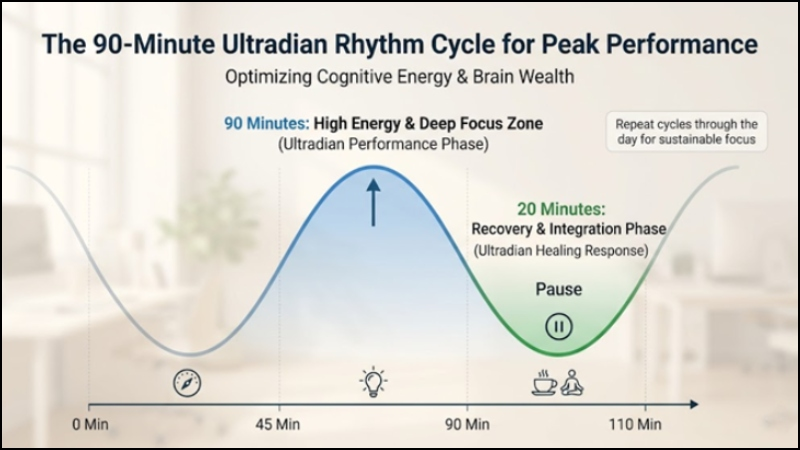
Your physical and digital surroundings act as the “trigger” for deep work. You cannot expect to reach peak performance if your phone is buzzing every thirty seconds or if your workspace is cluttered with reminders of unfinished chores.
- Digital Minimalism: Turn off all non-essential notifications. Every time you check a text or an email, it takes an average of 23 minutes to return to your original level of focus.
- The 90-Minute Block: The human brain operates in “ultradian rhythms.” Research suggests we can only maintain high-intensity focus for about 90 minutes before needing a 15-minute break.
- Physical Anchors: Use a specific scent, a certain playlist, or even a specific desk lamp that you only turn on when it is time for deep work. Eventually, your brain will associate these triggers with the flow state.
The Role of Nervous System Regulation
You cannot force your way into a peak performance zone if your body is in “fight or flight” mode. High levels of cortisol (the stress hormone) block the neural pathways required for creative problem-solving. This is why a “Sunday Reset” ritual—incorporating mindful breathing, light movement, and planning for the week—is so vital. When your nervous system feels safe, your brain is more willing to invest the high amounts of energy required for deep immersion.
If your “nervous system budget” is spent on worrying about deadlines, you have nothing left for actual performance. By delegating technical research or data-heavy sections of a project, you regulate your stress levels and keep your brain in the “Green Zone” of productivity.
Managing Cognitive Energy (Brain Wealth)
Think of your brain like a battery. Every decision you make, from what to wear to how to phrase a difficult sentence, drains a bit of that power. Peak performers protect their energy by automating or delegating low-value tasks. By the time most students reach their hardest project of the day, they are often suffering from “decision fatigue.”
This is where the concept of “Brain Wealth” comes in. Just as financial wealth allows you to invest in assets, Brain Wealth allows you to invest your best hours into your most important work. If you spend four hours struggling with bibliography formatting or basic data entry, you are bankrupting your cognitive potential. High achievers understand that their time is better spent on synthesis and high-level editing.
Practical Steps to Trigger Flow Today
To make this actionable, follow this 4-step protocol to enter the zone on demand:
- Identify the “Lead Domino”: What is the one task that, if finished, makes everything else easier or unnecessary? Start there.
- Clear the Path: Remove every possible obstacle before you start. Have your water, your notes, and your tools ready.
- Set a Clear Goal: Vague goals lead to vague results. Instead of “work on the paper,” try “write the 500-word introduction using three specific sources.”
- Embrace the Struggle: The first 15–20 minutes of any deep work session usually feel difficult. This is the “struggle phase.” If you push through it, the flow state is waiting on the other side.
Why Multimodal Learning Enhances Performance
In the modern era, reading text isn’t enough. Our brains are wired for multimodal input—visuals, audio, and kinesthetic movement. When you are stuck in a mental rut, try switching the medium. Draw a mind map of your current project. Record yourself talking through the main points of your thesis. This change in perspective often acts as a secondary trigger for the flow state, helping you bypass the “blank page syndrome” that kills productivity.
The Long-Term Impact of Peak Performance
Consistency is the quiet engine of success. Accessing the zone once is a fluke; accessing it daily is a strategy. Over months and years, the compound interest of deep work sessions builds a body of work that stands out for its depth and rigor. Whether you are aiming for academic honors or trying to dominate a professional niche, the quality of your focus determines the height of your ceiling.
Final Thoughts on High-Output Living
Accessing your peak performance zone on demand is a skill that can be developed with practice. It is about respecting your biological limits while pushing your intellectual boundaries. By optimizing your environment, regulating your nervous system, and knowing when to leverage professional expertise to manage your workload, you transform focus from a rare occurrence into a reliable habit.
When you master this rhythm, you don’t just get more done; you do better work with less stress. You move from being a passive participant in your daily schedule to being the strategist of your own success. Whether you are navigating complex academic requirements or leading a professional team, the “zone” is where your best self lives. Start small, stay consistent, and watch as your peak performance becomes your new baseline for excellence.
Frequently Asked Questions
What is the “Flow State” in productivity?
The Flow State is a psychological phenomenon where an individual becomes fully immersed in an activity. During this phase, self-consciousness drops away, and focus intensifies, leading to a sense of effortless progress and a distorted perception of time.
How long does it take to enter deep focus?
Research suggests that it typically takes about 15 to 20 minutes of concentrated effort to bypass initial distractions and enter a state of deep immersion. Frequent interruptions can reset this timer, making it difficult to reach peak performance.
Why is nervous system regulation important for performance?
A calm nervous system is a prerequisite for high-level cognitive function. When the body is in a state of high stress or “fight or flight,” the brain prioritizes survival over creative problem-solving, effectively blocking the path to the zone.
What is the best way to maintain focus during long tasks?
Working in “ultradian rhythms”—typically 90-minute blocks followed by a short break—aligns with the body’s natural energy cycles. This prevents cognitive fatigue and ensures that focus remains sharp throughout the day.
About The Author
Ruby Walker is a dedicated Senior Academic Consultant and content strategist at myassignmenthelp. Based in Singapore, she specializes in developing high-impact educational resources and research frameworks that help students achieve long-term academic success.
For more information and suggestions, please contact us.

Jack Ayzal is the lead editor of Trending Magazine. He focuses on practical home improvement, real-estate decisions, and local service guidance. For the past eight years he has researched contractor practices, spoken with homeowners and tradespeople, and tracked how local rules and market conditions affect everyday projects. His aim is to give readers clear, usable information they can act on without sales pressure.